
The Pirate Roots of Poland's Cyber Empire
The Pirate Roots of Poland's Cyber Empire
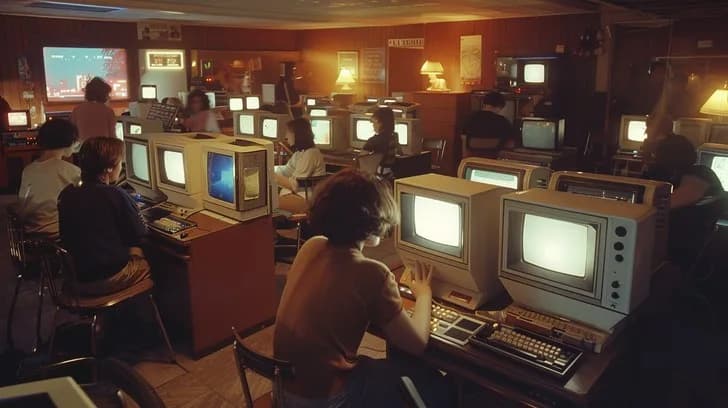
Today, Poland is a heavyweight in global cybersecurity, enterprise software, and game development, producing massive global exports like The Witcher and Cyberpunk 2077. The foundation for this tech empire was not a well-funded university initiative or a government tech grant. It was the Giełda Komputerowa (Computer Exchange) – a chaotic, unregulated weekend market operating in school gymnasiums, university cafeterias, and concrete parking lots across the country in the early 1990s.
When the Iron Curtain fell in 1989, Western technology flooded into Poland, but at impossible prices. An original copy of a new PC game or productivity software often cost a month's salary for an average Polish family. The Giełda emerged as the physical, grassroots solution to this economic barrier, inadvertently training a generation of elite programmers in the freezing rain.
The Economics of the Floppy Disk
In the early 90s, copyright law in Poland was virtually non-existent, leaving a massive legal gray area that tech-hungry teenagers exploited to the maximum.
Every weekend, thousands of people gathered at locations like the legendary Grzybowska Street in Warsaw. Vendors set up folding tables covered in thousands of unlabeled floppy disks and, later, burned CD-ROMs. You did not just buy games; you brought your own blank disks, handed over a small fee, and waited while a vendor copied the files from their Amiga or PC right in front of you.
The Giełda was the physical internet before the internet existed. It was where programmers exchanged code, graphic designers shared early rendering tools, and hardware enthusiasts bought smuggled motherboards and processors from Taiwan out of the trunks of cars.
The Demoscene and the Code Breakers
The real technical education happened behind the scenes. Because most Western games and software were protected by digital rights management (DRM), Polish teenagers had to learn how to break it.
To bypass copy protection on Commodore 64s, Amigas, and early PCs, kids taught themselves Assembly language, hex editing, and reverse engineering. They formed "crack groups" and participated in the "Demoscene" – a subculture where programmers competed to write the most visually impressive, highly optimized audio-visual presentations (demos) that could run on severely limited hardware.
This environment acted as an extreme, self-taught bootcamp. By tearing apart Western code to see how it worked, these teenagers acquired a deep, architectural understanding of computer systems. Decades later, this specific skillset transformed Poland into one of the most respected and feared cybersecurity hubs on the planet.
From the Concrete Lot to CD Projekt Red
The lineage from the Giełda to the modern multi-billion-dollar gaming industry is direct and unbroken.
In the mid-90s, two high school friends, Marcin Iwiński and Michał Kiciński, set up a small table at the Warsaw Giełda to sell CD-ROM games they imported from US wholesalers. They realized that to beat the pirates at the market, they had to offer something better than a burned disk in a plastic sleeve. They began legally translating games into Polish, hiring professional voice actors, and packaging them with heavy manuals and maps for a fair price.
They named their company CD Projekt. Today, they are the studio behind The Witcher series and Cyberpunk 2077. Tech giants like Techland (Dying Light) and countless Polish cybersecurity firms trace their origins to exactly the same weekend trading lots.
90s Polish IT Terminology
| Polish Term | Pronunciation | What It Meant |
|---|---|---|
| Giełda Komputerowa | GYEW-dah kom-poo-teh-ROH-vah | The computer exchange market. |
| Pirat | PEE-raht | A pirated copy of software or a game, or the person selling it. |
| Dyskietka | dis-KYET-kah | Floppy disk (the primary currency of the early 90s exchanges). |
| Zgrywać | ZGRUH-vach | To rip or copy data from one disk to another. |
| Piractwo komputerowe | pee-RAHTS-tvoh kom-poo-teh-ROH-veh | Software piracy. |
| Scena | STSEH-nah | The Demoscene (the underground programmer subculture). |
Resources for Tech History
- Warsaw Apple Museum & Museum of Computers: If you visit Warsaw, dedicated tech museums hold massive collections of the exact hardware (Amigas, Odras, early PCs) that fueled the 90s revolution.
- "Jesteś Bogiem" (Tech Parallel): While this movie is about the Polish hip-hop scene in the 90s, it perfectly captures the raw, entrepreneurial, gray-market energy of Poland during the transition period when the Giełda thrived.
- CD Projekt Red Documentaries: Numerous YouTube documentaries by gaming journalists (like Noclip's series on The Witcher) extensively cover the company's origins at the Warsaw computer market.
Further reading

2 Sept 2026

25 Aug 2026